


Namaz Timing Karachi today, 16 Mar, 2026 (28 Ramaḍān 1447), is essential if you live in Karachi, Pakistan, and want to perform your five daily prayers on time. Here is the accurate namaz timing today in Karachi for each prayer.
- Fajr: 05:23 AM
- Dhuhr: 12:40 PM
- Asr: 16:05 PM
- Maghrib: 18:41 PM
- Isha: PM
These prayer times follow the University of Islamic Sciences, Karachi calculation method. If you follow a different school of thought, you may need to adjust slightly based on local mosque schedules.
Fajar Namaz Timing Karachi
Fajar is the first prayer of the day, marking the transition from night to dawn. In Karachi today, Fajar prayer starts at AM and ends at AM.
Praying at this time is a spiritual commitment that brings peace before the day begins. Many wake up before dawn for Tahajjud, a voluntary prayer that is highly recommended. After Fajar, Ishraq prayer can be performed once the sun has fully risen.
Fajar is unique because it is the only Salah with two Rakats that are Farz (obligatory), followed by two Sunnah. Missing it means waiting until Zuhr for the next prayer, so staying consistent helps maintain a routine.

Dhuhr Namaz Timing Karachi
Dhuhr prayer is performed when the sun begins to decline from its highest point. In Karachi today, Dhuhr starts at PM and ends at 16:05 PM.
This midday prayer serves as a pause from daily responsibilities, allowing a moment of reflection and spiritual connection. It consists of four Rakats Sunnah, followed by four Rakats Farz, then two Rakats Sunnah, and finally two Rakats Nafl (optional).
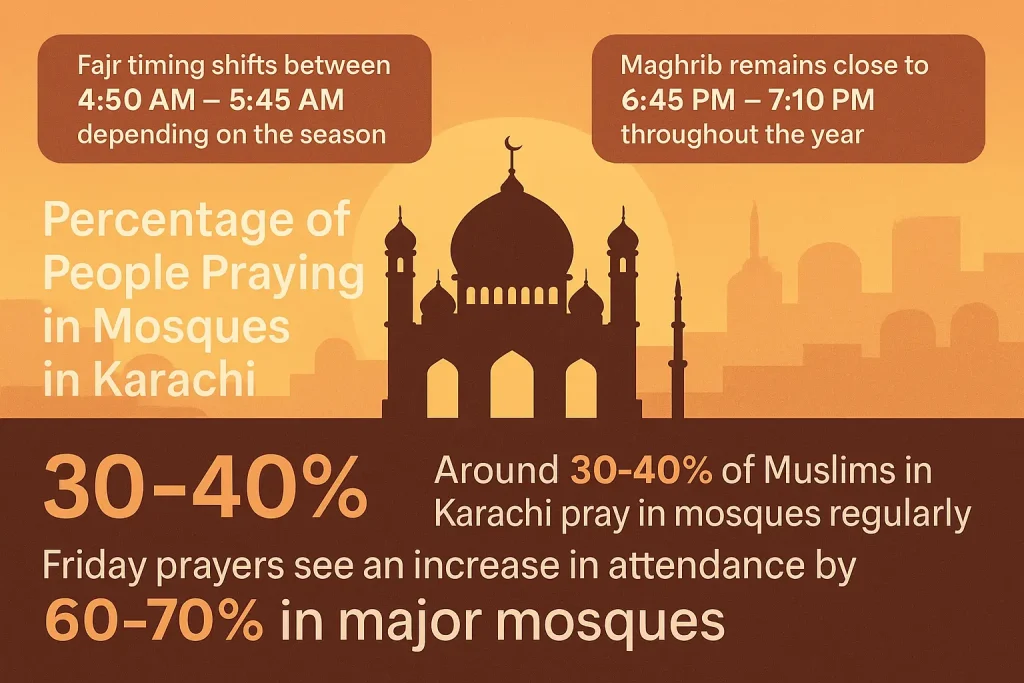
During work or school hours, many find it convenient to pray Dhuhr in nearby mosques or designated prayer areas. In Karachi, mosques like Masjid-e-Tooba, Grand Jamia Mosque, and Baitul Mukarram Masjid see a large number of worshippers at this time.
Asr Namaz Time Karachi
Asr prayer holds a special place as the afternoon Salah before sunset. Today in Karachi, Asr starts at 16:05 PM and ends at 18:41 PM.
There is a difference in Asr timing based on the Hanafi and Jafria schools of thought:
- Hanafi Method: Asr starts later, once the shadow of an object is twice its length.
- Jafria (Shia) Method: Asr begins when the shadow equals the object’s length.
The prayer consists of four Rakats Sunnah, followed by four Rakats Farz. Missing Asr means missing a significant opportunity for spiritual rewards, as this is a time when prayers are strongly encouraged.
As the day winds down, many find Asr to be a moment of clarity before the evening rush begins. In Karachi, people returning from work or school often stop by mosques before heading home, making it a time of collective worship.
Maghrib Namaz Timing Karachi
Maghrib prayer marks the end of the day, beginning just after sunset. In Karachi today, Maghrib starts at 18:41 PM and ends at 19:57 PM.
This is a significant time, especially during Ramadan, when the fast is broken as soon as the call to prayer (Azan) is heard. Many mosques in Karachi, such as New Memon Masjid and Masjid-e-Tooba, are filled with worshippers at this hour.
The Maghrib prayer consists of three Rakats Farz, followed by two Rakats Sunnah, and two Rakats Nafl (optional). The time between Maghrib and Isha is short, making it important to offer this Salah without delay.
Isha Namaz Timing Karachi
Isha is the final prayer of the day and offers a moment of peace before resting. In Karachi today, Isha starts at 19:57 PM and remains valid until Fajr at AM.
This prayer consists of four Rakats Sunnah, four Rakats Farz, two Rakats Sunnah, two Rakats Nafl, three Rakats Witr, and two more Nafl (optional).
For those who stay awake late, Tahajjud prayer can be performed after Isha, offering a deeper spiritual connection. Many in Karachi prefer to pray Isha at mosques like Grand Jamia Mosque or local neighborhood masjids, where the congregational prayer brings a sense of unity.
As the night settles, Isha serves as a reminder to reflect, seek forgiveness, and prepare for the next day with a clear heart.
Average Time Taken for Each Prayer
Fajr: 5-7 minutes
Dhuhr & Asr: 8-10 minutes
Maghrib: 6-8 minutes
Isha (Including Witr): 10-15 minutes
About Namaz Timing Karachi
Karachi aik bara sheher hai jahan har roz hazaaron log namaz timing Karachi check karte hain taake apni ibadat waqt par ada kar sakein. Islam mein namaz ka aik muqarrar waqt hai, jo rozana badalta rehta hai, isi wajah se namaz timing Karachi today jese jaise din aage barhta hai, badal jati hai. Har namazi ko chahiye ke woh today namaz timing Karachi ke mutabiq apni salah ada kare.
کراچی میں نماز کے اوقات ہر روز بدلتے ہیں کیونکہ یہ سورج کے طلوع و غروب پر منحصر ہوتے ہیں۔ نماز کا صحیح وقت جاننا ہر مسلمان کے لیے ضروری ہے تاکہ وہ اپنی عبادات کو بروقت ادا کر سکے۔ آج کراچی میں فجر، ظہر، عصر، مغرب اور عشاء کے اوقات درج ذیل ہیں:
- فجر: صبح (ختم ہونے کا وقت صبح)
- ظہر: دوپہر (ختم ہونے کا وقت 16:05 شام)
- عصر: 16:05 شام (ختم ہونے کا وقت 18:41 شام)
- مغرب: 18:41 شام (ختم ہونے کا وقت 19:57 رات)
- عشاء: 19:57 رات (اگلی فجر تک)
Namaz time Karachi today ka ehtram har musalman par lazim hai. Namaz sirf ek farz ibadat nahi, balki yeh zindagi ka aik behtareen tareeqa hai jo insaan ko har roz behtareen tareeke se jeene ka salika sikhata hai.
Weekly and Monthly Namaz Timetable Karachi
Staying consistent with daily prayers becomes easier when a weekly or monthly namaz schedule is available. Here is the namaz timetable for Karachi for the upcoming days:
Karachi Weekly Namaz Timings
| Date | Fajr | Dhuhr | Asr | Maghrib | Isha |
|---|---|---|---|---|---|
| Mar 24, 2025 | 5:16 AM | 12:38 PM | 5:02 PM | 6:45 PM | 8:01 PM |
| Mar 25, 2025 | 5:15 AM | 12:37 PM | 5:01 PM | 6:44 PM | 8:00 PM |
| Mar 26, 2025 | 5:14 AM | 12:36 PM | 5:00 PM | 6:43 PM | 7:59 PM |
| Mar 27, 2025 | 5:13 AM | 12:35 PM | 4:59 PM | 6:42 PM | 7:58 PM |
| Mar 28, 2025 | 5:12 AM | 12:34 PM | 4:58 PM | 6:41 PM | 7:57 PM |
| Mar 29, 2025 | 5:11 AM | 12:33 PM | 4:57 PM | 6:40 PM | 7:56 PM |
| Mar 30, 2025 | 5:10 AM | 12:32 PM | 4:56 PM | 6:39 PM | 7:55 PM |
For those who prefer a monthly schedule, the namaz timings for Karachi follow a similar pattern with minor daily adjustments due to seasonal changes. Ramadan, Eid, and other special prayers follow the same method of calculation but often see greater congregations in mosques.
Having a printed schedule or using a mobile prayer timing app helps in planning salah times throughout the month. Many mosques in Karachi also display the updated prayer schedule on noticeboards for easy reference.
Karachi Population & Number of Mosques
Karachi’s estimated population in 2025: 18 million
Approximate number of mosques: Over 3,000
Namaz Timings in Karachi Pakistan by Islamic Jurisprudence
Prayer times can slightly differ based on Islamic schools of thought. In Karachi, the majority follow the Hanafi (Sunni) method, while Jafria (Shia) prayer timings vary for a few prayers, mainly Asr and Maghrib.
Hanafi (Sunni) Namaz Timings in Karachi
The Hanafi school of thought calculates prayer timings using a slightly delayed approach, particularly for Asr. This is the widely followed method in majority of mosques in Karachi.
Jafria (Shia) Namaz Timings in Karachi
For Shia Muslims, the Asr prayer starts earlier, and Maghrib is prayed a little later compared to the Hanafi timetable. Many Jafria mosques in Karachi display separate prayer schedules.
Understanding these differences in prayer times ensures that everyone follows their respective jurisprudence correctly. Many Islamic apps also allow users to switch between different calculation methods based on their religious preference.
For greater accuracy, it’s best to confirm namaz timings with local mosques, as slight variations may exist due to location-based calculations.
How Namaz Timing Karachi Is Calculated
Namaz timings are determined using precise astronomical calculations based on the movement of the sun. Various Islamic institutions and organizations use different calculation methods, which can result in slight variations in prayer times.
In Karachi, the University of Islamic Sciences, Karachi is the most widely followed calculation method. However, there are other globally recognized systems as well.
Main Methods of Calculating Namaz Timings in Karachi
- University of Islamic Sciences, Karachi
- Commonly followed by Hanafi (Sunni) Muslims in Pakistan.
- Uses standard formulas for Fajr, Asr, and Isha based on the angle of the sun below the horizon.
- Most mosques and Islamic centers in Karachi rely on this method.
- Umm Al-Qura University, Makkah
- Primarily used in Saudi Arabia but followed by some in Pakistan.
- Fajr and Isha are calculated using fixed angles of the sun (18° for Fajr, 90 minutes after Maghrib for Isha).
- Slightly different from the Karachi method, particularly for Fajr and Isha timings.
- Muslim World League (MWL)
- A widely accepted international method used across various countries.
- Uses 18° for Fajr and 17° for Isha calculations.
- Often used in mobile prayer apps, allowing customization based on regional differences.
- Egyptian General Authority of Survey
- Used in Egypt and surrounding regions.
- Similar to MWL but with slight variations in twilight angle calculations.
- Shia Ithna-Ashari (Jafria) Method
- Jafria prayer times differ for Asr and Maghrib.
- Maghrib is delayed until complete sunset redness disappears.
Why Do Namaz Timings Differ Slightly?
The reason prayer times vary across different locations is due to the difference in how each method calculates twilight angles for Fajr and Isha. Some methods rely on fixed intervals, while others use astronomical positioning.
For Karachi residents, checking prayer times from local mosques ensures they follow the correct schedule. Many people also use Islamic apps that allow switching between different calculation methods based on personal preference.
Most mosques in Karachi follow the University of Islamic Sciences, Karachi method, making it the most reliable source for daily namaz timings in the city.
Conclusion
Following accurate namaz timings in Karachi ensures that each prayer is offered on time, strengthening spiritual discipline. The daily prayer schedule changes slightly throughout the year due to the movement of the sun, making it important to check updated timings regularly.
Most mosques and Islamic institutions in Karachi rely on the University of Islamic Sciences method, but alternative methods like Umm Al-Qura and Muslim World League are also used by some. Those following Hanafi (Sunni) and Jafria (Shia) jurisprudence may notice slight timing differences, especially for Asr and Maghrib.
Staying informed about weekly and monthly prayer schedules helps in maintaining a consistent routine. Whether at home, work, or traveling, having access to updated namaz times ensures prayers are performed at the right time.